
Astronomy Equipment & System Integration
After taking on an equipment and system integration project, we assess the operational goals, select suitable equipment, define interface requirements, complete system integration and testing, install the system, and hand it over for use.
This is more than a simple equipment purchase—it is a complete systems engineering solution built around real-world operation.
For schools, research institutions, science museums, professional astronomical observation, and other application scenarios.
Equipment Selection
Interface Planning
System Coordination
Imaging & Observation
Installation & Commissioning
Reliable Operation
How We Approach a Project
Define the Use Case
Understand the project goals, application scenarios, observation requirements, and expected outcomes.
Assess the Conditions
Evaluate the site environment, infrastructure, available resources, and system requirements.
Match the Equipment
Select suitable equipment based on project needs, integrate it with supporting systems, and plan for future scalability
Complete Delivery
Through testing, installation, and training, we ensure stable system operation and complete project handover.
What We Do After Taking On an Equipment & System Integration Project
From requirements analysis through training and handover, we turn operational goals, equipment selection, interface specifications, and system coordination into an implementable solution.
01
Requirements Analysis
Understand project goals, use cases, and technical requirements.
02
Equipment Selection
Select suitable telescopes, cameras, and supporting equipment.
03
Interface Planning
Define equipment interfaces, communication protocols, and system architecture.
04
Integration Design
Develop the system integration plan and interface design.
05
Factory Testing
Perform factory integration testing to verify system functionality.。
06
On-Site Installation
Complete equipment installation and cabling on site.
07
Integrated Commissioning
Commission interconnected systems and optimize operating performance.
08
Training & Handover
Provide user training and documentation, then complete project handover.
What We Do After Taking On an Equipment & System Integration Project?
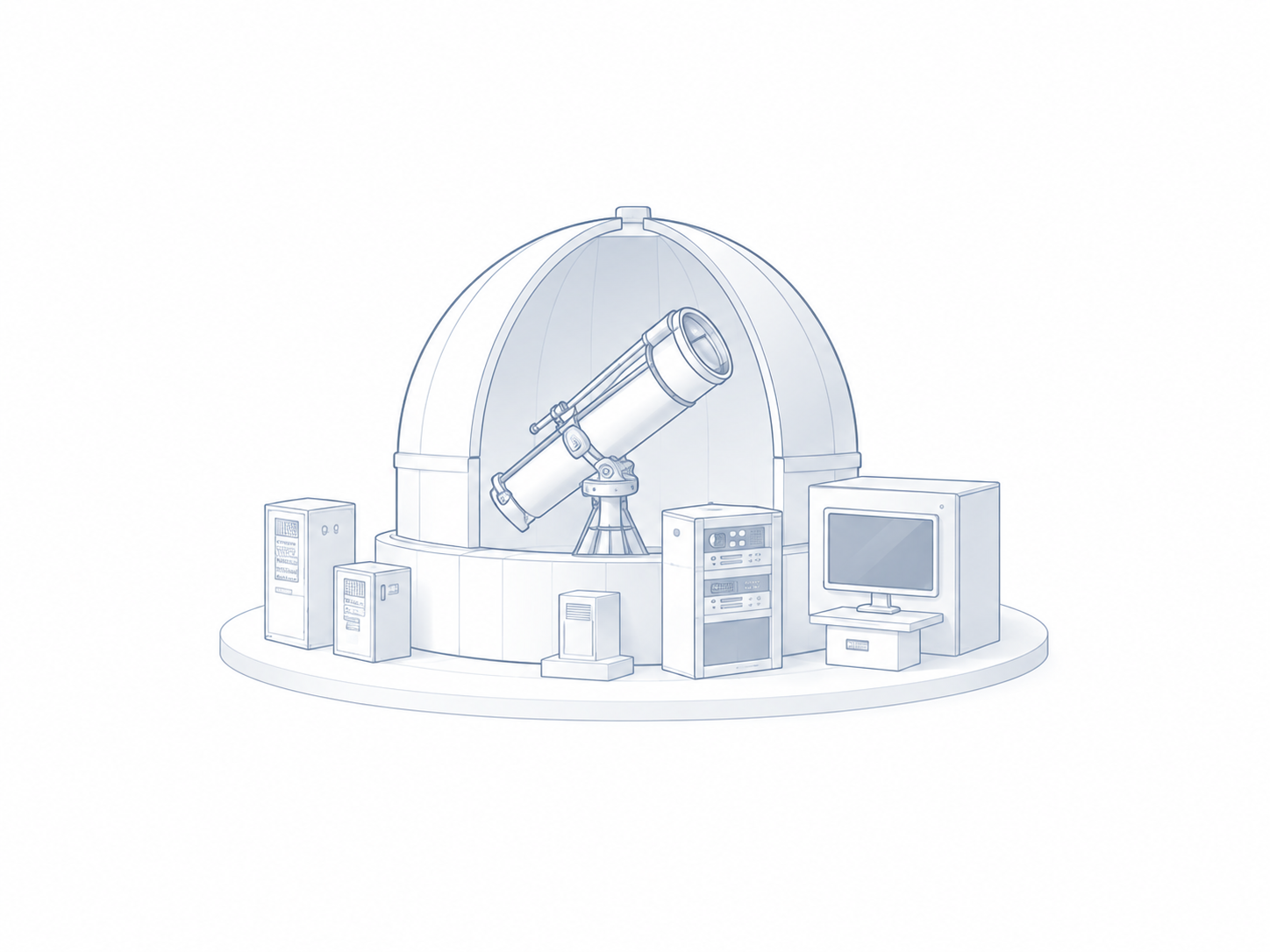
System integration is more than combining equipment. It brings observation, control, imaging, safety, electrical, and network systems together as one coordinated platform.
Astronomical Dome
Provides an observing enclosure with automated opening, environmental control, and safety protection.
Telescope & Equatorial Mount
Provides celestial tracking and observation with high pointing accuracy and stability.
Cameras & Imaging Equipment
Supports astronomical imaging, data acquisition, and image processing.
Astronomy Equipment & System Integration
Multiple Devices · Multiple Systems · Coordinated Operation
Control & Software Systems
Enables equipment control, observation planning, data management, and remote access.
Weather & Safety Monitoring
Monitors weather, environmental conditions, and equipment status to ensure safe operation
Electrical / Network / Structural Interfaces
Integrates power, network, and structural interfaces for stable and reliable system operation.
How We Configure Solutions for Different Projects?
Different projects have different users, observing requirements, and operating modes, so the equipment and system configuration should be matched accordingly.
Basic Teaching System
- Meets school teaching needs
- Simple and practical configuration
- Focuses on ease of use and safety
Public Science Display System
- Designed for public science education
- Supports large-screen display and interaction
- Stable operation and easy maintenance
Professional Observation System
- Designed for research and advanced observation
- High precision and high stability
- Supports customization and expansion
What We Deliver?
01
Equipment & Systems
Complete equipment and integrated systems
02
Installation & Commissioning Report
Detailed testing and commissioning report
03
User Training
On-site training and operating guidance
04
Technical Documentation
Detailed instructions and system documentation
05
After-Sales Support
Warranty and long-term technical support
06
Stable Operation
Reliable long-term operation after handover
Information to Prepare Before the Project Starts
Once this basic information is clear, we can evaluate equipment configuration, system scope, and implementation paths more efficiently.
01
Project Goals
Teaching / public outreach / research / other use
02
Site Conditions
Site location, building conditions, and environment
03
Budget Range
Project budget and implementation plan
04
Special Requirements
Any special requirements for equipment, functionality, or appearance
05
Schedule
Desired construction timeline and delivery date
FAQ
How long does a system integration project typically take?
The schedule depends on equipment configuration, level of customization, interface complexity, site conditions, and delivery scope. The more clearly the requirements and interfaces are defined in advance, the more efficiently the project can proceed.
How is the system maintained and upgraded after completion?
Operation and maintenance documentation is provided at handover. We can also offer maintenance, upgrade, and expansion recommendations based on equipment life cycles, software versions, and evolving operational needs.
Can the system be customized for an existing site?
Yes. We can adapt interfaces and system configurations based on the existing building, power supply, network, available space, and observing conditions.
Do you provide long-term technical support?
Yes. Long-term technical support, remote assistance, maintenance recommendations, and future system expansion services can be provided according to the project agreement.
From Individual Equipment to a Fully Coordinated System.
Jiangsu SKH Optoelectronic Technology Co., Ltd. is committed to providing reliable, professional, and sustainable astronomy equipment and system integration solutions for every project